


Unlocking the Past: A Conversation with Professor Eske Willerslev
On April 9, 2024, the Academia Europaea Wrocław Knowledge Hub had the distinct honour of hosting Professor Eske Willerslev for a public lecture titled “What Can We Learn from Ancient Genomics?” The event brought together scholars and students from across disciplines to engage with one of the foremost voices in evolutionary genetics.
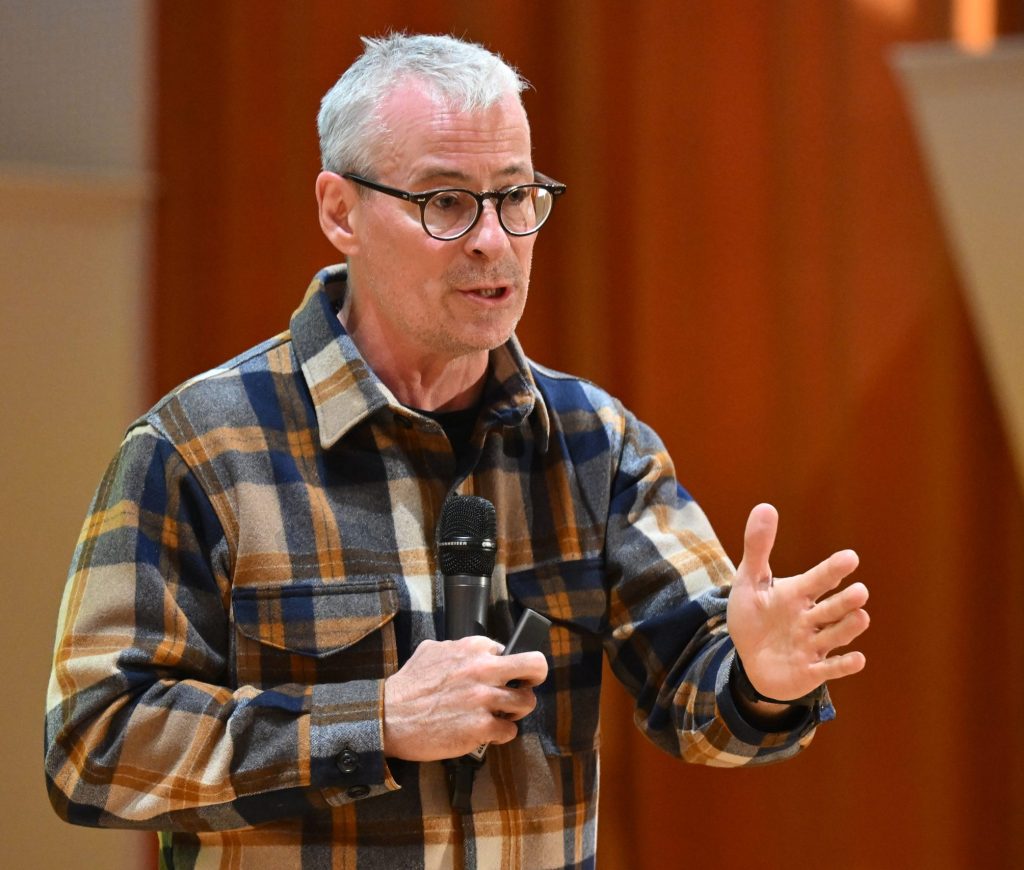
We are now pleased to share an exclusive interview with Professor Willerslev—a pioneering figure in evolutionary genetics and a leading figure in global science. A member of Academia Europaea, directs the Centre for Ancient Environmental Genomics (CAEG) at the University of Copenhagen and holds a professorship at the University of Cambridge.
Over the past two decades, Professor Willerslev’s pioneering research has transformed our understanding of human prehistory, migration patterns, and ecological change. From extracting DNA from Ice Age sediments to sequencing the genomes of long-extinct species, his work bridges genetics, archaeology, and environmental science in profoundly innovative ways.
In this conversation, Professor Willerslev discusses the thrill and complexity of pushing scientific and social boundaries, the ethical considerations of working with ancient human remains, and how ancient DNA research can inform some of the most urgent questions of our time. His reflections offer a rare glimpse into the mindset of a scientist deeply committed to exploring humanity’s shared past while looking toward the future.
You can also listen to the full interview on Spotify
Magdalena Filipow: What key insights can we gain from ancient genomes about human evolution and our ancestors migration patterns?
Professor Eske Willerslev: – We can get a lot of insights and I think it has all already changed. I mean, ancient DNA has already changed the way we look at our human evolution and, and how we become who we are. And there are different things you can look at.
You can look at migration, you can look at which populations groups mixed with each other at what time points you can look at. You can see how different populations adapted to different climates, etcetera. And one of the things where I think it has proven very important is that in classical archaeology, if you find the skeleton or you find, let’s say, a sword or something, right? Let’s say you find a Roman sword here in Poland. You don’t know whether that sword was traded up here or the Romans were here, right?
So, so this is what ancient DNA can tell you. If you get the skeletons, we can actually look, if any Romans were here or if they mix up with the Polish population at the time or whatever? So in that sense, it’s very powerful tool.
The next question would be, what are the biggest challenges in ancient genomics today, and which research direction do you find most promising for the future?
Well, I think it’s interesting because you know, if we go back 10-15 years ago, the biggest challenge in ancient DNA was the trouble with contamination. The problem was how to basically separate you can say contaminant modern DNA from ancient DNA and that has created a lot of problems in how to interpret your data. Today this is not really a big problem anymore. Today the challenge is really analyzing the data. It’s like you can say how to manage the data for information.
And if you take, for example, what I talked about environmental DNA back in the past, where you take it from soil, imagine you have tiny pieces of DNA, short pieces of DNA from many, many different organisms in one sample. And you have to find out, which pieces belonging to which Organism. And it is not a trivial question.
So today the biggest challenges lies within, you can say what we call bioinformatics, meaning how to statistically analyze the data in a meaningful way.
Yes, but as you said, it’s hard to distinguish which DNA is from when and from what, and what are the tools?
Well, the tools are, you can say reference genomes, you know, So this is genomes from living organisms, right? So luckily, the good, the good thing here is that we are increasingly sequencing all life on this earth, right? So we, you can say the reference genome databases are increasing and increasing and increasing. And this helps severely help these problems about, well, what piece of DNA is belonging to what Organism, what is the closest living Organism to this piece of DNA. But it’s, it’s super important with these reference genomes because if you don’t have the right ones, I mean, you are really stuck. You don’t really know what is your DNA from. Maybe you can say, well, it’s a plant. You can maybe say, well, it’s, it’s maybe from the Rosace family or something. But that doesn’t bring you much further than that, right? So it’s all about getting the reference genome. So a part of what we do is when we go into an area, let’s say we wanted to work here in Poland, right? We would go and say, OK, what has been sequenced that are present in Poland already and what are we lacking and the stuff we are lacking then we will go in sequencing it right for comparison and maybe some of the areas around Poland as well to have good comparisons. So this is this is one of the I would say the challenges, but we are getting there.
Can you date some species as markers from different mutations?
Well, yes, so you can date the sample itself, right in many cases. So if you have for example a human bone, you can make a C14 date right of this human bone and it if it’s younger than 50,000 years, you should be able to get a date right.
And the same is with the sediments, you can date the sediments, you can either take out some organic material and date that with C14 date or you can use other types of dating which is the date of the sediments itself, luminescence dating for example.
But if you go enough back in time, you can actually use the DNA itself also for dating using so-called molecular clocks.
If you have an idea of the mutation rate of a certain gene in a certain group of Organism, you can then compare the sequence you have from that Organism right back in time to its present day relative and ask how many mutations it is the different. And if you know the mutation rate right, you can then calculate and say, OK, how long is that? And very often we, especially when we work very far back in time, we are doing both right. We are both using the DNA itself and we’re using, you can say geological dating methods and the two things should match.
Your academic journey is quite unique: Before becoming a professor of genetics, you worked as a trapper in Siberia.
Yes….
And what did that experience influence your decision to pursue an ancient DNA in genomics?
Yeah, it’s a good question. To be completely honest, I, I turned out to be a pretty poor tramper. I mean, I wasn’t very good at it because, I was together with people who had been, you can say, who were born into this. They were born in northeastern Siberia and Yakutia Saha in, in Siberia. And the people I was together with, well, they, they were basically born with a gun. And I came there as a young man in my early 20s. So I wasn’t particularly good at it, but it was a very important experiment experience…In a sense, you can say it made me, it made me interested in nature. And, and it made me interested in people and in understanding where we’re coming from. It also made me interested in mammoth, for example, because we were founding all these mammoth bones and tusks and stuff. It made me interested in all these things.
I was first an expeditioner doing expeditions in Siberia and then finally being a trapper there. A lot of the questions I asked myself back then a lot of questions, for example, what what is the relationship between Siberians peoples and Native Americans?, what was the reason for the extinction of the woolly mammoth?
All those questions, you know, were questions I asked myself when I was young and was out there, but then I could try to answer them when I became a scientist.
So I’ve got very inspired by being out there, but I’m happy that I have chosen my scientific career rather than staying in the trapping business.
You mentioned not just traveling, but actively going out and searching for answers—especially considering how migration played a role in past populations. And you’re a big supporter of the idea that we should travel and explore, aren’t you?
I think it’s very important for any young person to spend time visiting different parts of the world. I think, what anyone will find, will give you a greater perspective of things. There are things that you can learn and say, well, I actually want to take this with me right in my life journey. And there’s also things everywhere where you say, well, I don’t really want to take this with me. It gives you a perspective because suddenly you see that things can be done differently from where you were born and raised.
It also makes you curious, It gives you ideas to what you want to do in life, right, and how you want to live your life. So it’s something that anyone should get a chance to experience.
And I think particularly when you are young, because when you get older, you get to settled and worried and and things like that. So I think it’s something you need to do while you can say you have the courage and you have the curiosity.
As you wisely said previously that it’s not only about adapting always, it’s about finding the right environment.
Exactly, you find out that there is a different environment in the world, different ways of living, and you might even learn that one of these are actually better suited to you than what you came from. But in any event. I’ve learned is that you meet all these different amazing cultures around the world, but wherever you go, there are good people. And this is also important to remember. When there’s conflict and all these things, doesn’t mean that all people on the other side are bad, right?
And next question would be, has there been a particular discovery or history in your research that deeply moved you, something that changed the way you see humanity?
I have to say there has been many things that have changed my way of looking at humanity or looking at the world as such. One thing, for example: I wasn’t very worried about climate change. I mean, I was one of those that were like, well, climate have always changed and it’s not so dangerous. And then I saw the results from our own research of how climate change can result in a complete collapse of ecosystem around the world. And it went very fast. And so, these people 10,000 years ago would have watched the world they knew falling apart while a new one emerged—and it made me realize that rapid climate change, especially now with the human factor speeding things up, can be incredibly disruptive.
There were also other instances, for example, I was born in in a generation where we learned at school about different human races, for example. And I had the kind of the idea that every time you saw somebody from different race, was actually very different from you.
Now we know that our history is so recent that it doesn’t matter what color you have, what kind of clothes you are wearing. I mean, it’s really a very, very close relative of yourself.
And that also has changed the way I’m looking at people, when I am meeting them.
Your research has greatly impacted evolutionary genetics and related fields. Since sequencing the first ancient human genome in 2010, you’ve made many breakthroughs. Which discovery has been the most personally meaningful to you?
I think actually my my most valuable discovery is really one of my first discoveries, namely this about reconstructing ecosystems from ancient soil, I mean plant and animal diversity.
It’s it’s not maybe the one where I’m most famous but I think it’s the most important.
It was so different from what people thought at the time.
IN some of the other work I’ve been doing, I was the first one. But with this discovery, it was so ahead of its time, that it wasn’t just the next logical step. It was, I would say 10 steps ahead or 20 steps ahead of the way people were thinking. It had had a huge impact already in terms of biodiversity monitoring time and space. I would say for me, it’s, it’s the one that I’m most proud of.
Thank you very much. I have the last question: what would you say to a young person unsure of their life path, someone wondering if it’s worth following curiosity? Can passion and science truly go hand in hand?
I think one thing I would say to a young person is to see, whatever career you choose is whether it’s science or something else: If you are really passionate about what you’re doing, you will make money out of it. You will, I’m not saying you will be super wealthy, but you will be able to make a living from it if you’re really passionate, because if you’re really passionate about what you’re doing, you will also become very good at it.
And yes, if you are an artist or a writer or whatever, of course you can see the challenges oof making a breakthrough. Living from it is harder than if you’re a medical doctor. But it doesn’t mean it’s impossible. So if you’re passionate, you will go through, because at the end of the day, it’s a lot about how many hours do you put into what you do. And to put in many hours, you need to like it. If you don’t like it, it’s a nightmare.
I would definitely encourage people to go with their passion and also take some time not to rush through. After high school, maybe take a break and and kind of really go out traveling the world. And find out what is your passion, what really interests you. And then I would go and follow that dream. That will be my advice.
Thank you very much, professor, that was an honor for me.
My pleasure.


