


Climate Shock: How Climate Change can Trigger the Next Sovereign Debt Crisis
March 26th at 13.15 (CET)
Congress Hall, Building D-20, Janiszewskiego 8, Wrocław
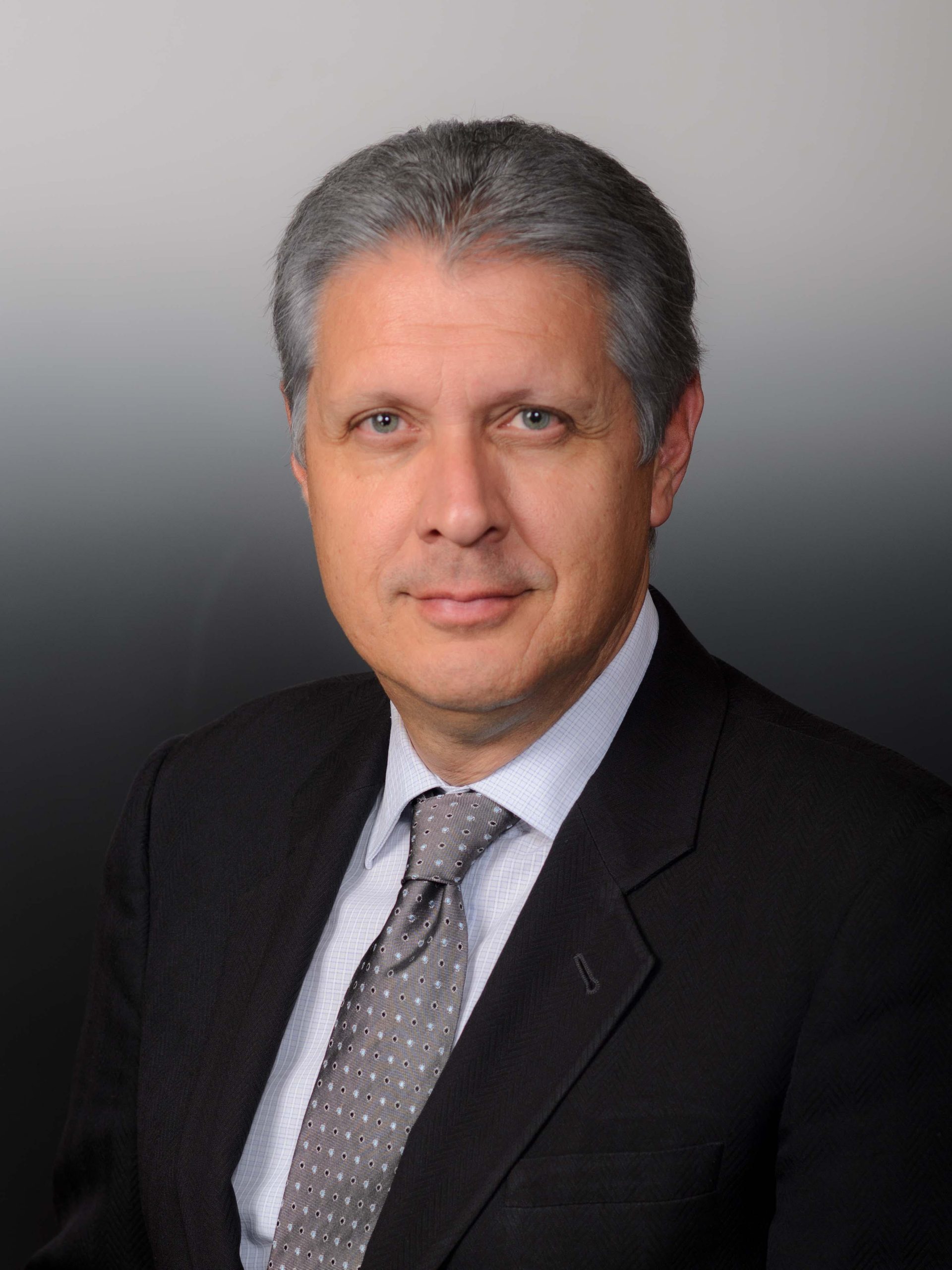
Join the live streamSovereign exposure to climate risk is no longer theoretical: it is priced by financial markets and reflected in credit ratings and debt servicing costs. On Thursday, 26 March 2026, Stavros A. Zenios, Professor of Operations Management and Finance at the Durham University and a member of Academia Europaea, will deliver a lecture examining how climate risk reshapes public debt dynamics and constrains the fiscal space available to finance climate policy.
The lecture, titled “Climate Shock: How Climate Change Could Trigger the Next Sovereign Debt Crisis,” will take place at the Congress Hall of Wrocław University of Science and Technology (Building D-20, 8 Janiszewskiego Street) at 13:15 CET.
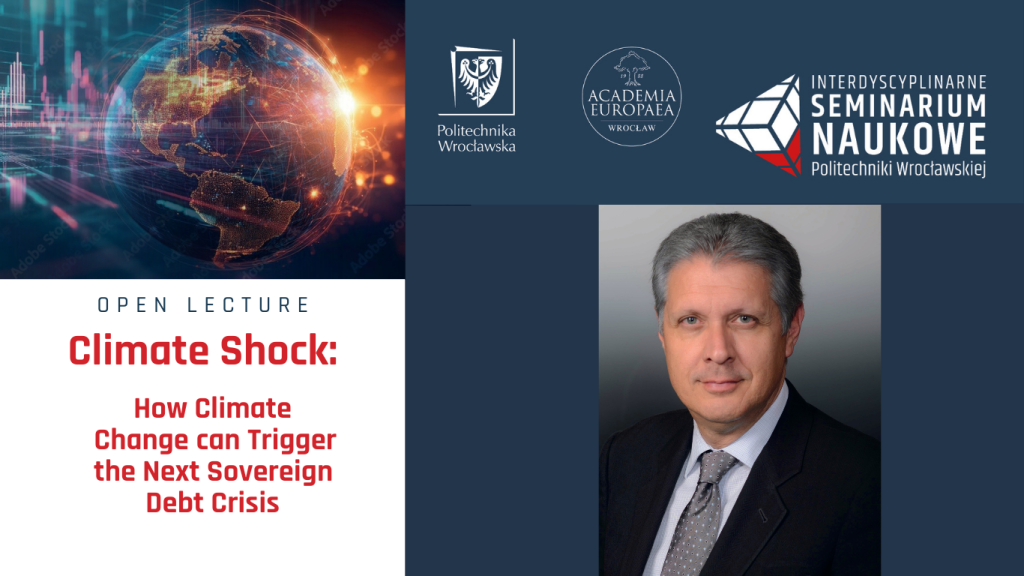
The exposure of sovereign states to climate risk is no longer a theoretical issue—it is priced in financial markets and increasingly reflected in credit ratings and debt servicing costs. This lecture invites participants to examine how climate change is reshaping public debt dynamics and how advanced modelling frameworks can help policymakers anticipate and manage these risks.
At the core of the discussion is the integration of integrated assessment models (IAMs) with stochastic debt sustainability analysis (DSA). Linking climate–economy models with fiscally realistic policy frameworks makes it possible to trace how physical damages, transition policies, and macroeconomic adjustments affect public finances. The lecture will demonstrate how such integrated modelling can support assessments of fiscal space and the sustainability of climate-related investments.
Drawing on the scenario architecture of the Intergovernmental Panel on Climate Change and the transition pathways developed by the Network for Greening the Financial System, the session presents a structured approach to analyzing both physical and transition risks under deep uncertainty. Methods such as scenario trees, narrative scenarios, and model ensembles are used to address risk, ambiguity, and model uncertainty.
BIO:
Stavros A. Zenios is Professor of Operations Management and Finance at Durham University and a Member of Academia Europaea. He is also a Non-resident Fellow of Bruegel (Brussels), Professor of Finance and Management Science at the University of Cyprus, and a Member of the National Academy of Cyprus.
He authored two books and numerous articles in leading international journals in risk management, financial engineering, and management science. He is currently working on sovereign debt sustainability issues, including the effects of climate change and the pricing of political risks. His work on personal financial planning received the 2006 EURO Excellence in Practice Award, and he also received awards for work on the performance of financial institutions. He was awarded twice Marie Sklodowska-Curie fellowships by the European Commission. His work on financial modeling and robust optimization is cited extensively, and his book Practical Financial Optimization (Blackwell-Wiley) is used in advanced classes in European and North-American Universities. His book with Patrick Harker on the Performance of Financial Institutions (Cambridge University Press) was translated in Chinese, and in 1997 he received the INFORMS prize for his book with Yair Censor Parallel Optimization (Oxford University Press).
Admission is free, but prior registration is required.
Registeration
Online transmission, check a link

The Interdisciplinary Scientific Seminar is a series aimed at a wide audience – students, doctoral candidates, researchers, and anyone interested in expanding their knowledge. Wrocław University of Science and Technology regularly hosts experts from various fields who are eager to share the results of their research.
ISN attendees have had the opportunity to listen to, among others, the 2023 Nobel Prize laureate in physics – Prof. Ferenc Krausz, renowned architect and urban planner – Prof. Kees Christiaanse from ETH Zurich, world-famous cognitive science expert Prof. Peter Gärdenfors from Lund University, Prof. Szymon Malinowski – Chair of the Polish Academy of Sciences’ Climate Crisis Committee, as well as Finnish researcher Prof. Tomi Kauppinen from Aalto University, Dr. Karolina Ćwiek-Rogalska from the Institute of Slavic Studies of the Polish Academy of Sciences, the creator of the psychological theory of implementation intentions Prof. Peter Gollwitzer from New York University, and Prof. Stephen Evans – Director of Research in Sustainable Development at the University of Cambridge.
March 26th at 13.15 (CET)
Congress Hall, Building D-20, Janiszewskiego 8, Wrocław
Join the live stream