


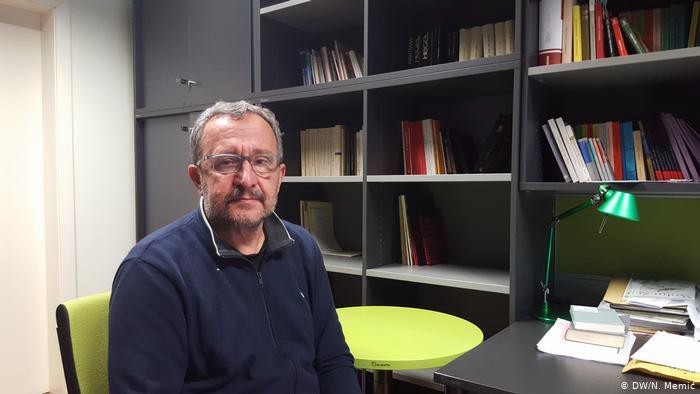
Vladimir Biti
Vladimir Biti is Visiting Professor at the School of International Studies, Zhejiang University and at the Institute of Arts and Humanities, Shanghai Jiao Tong University. He is a specialist in literary, cultural and narrative theory; modern South Slav literatures and cultures and
in post-imperial literatures. His recent publications include: Tracing Global Democracy: Literature, Theory and the Politics of Trauma, Berlin and Boston: Walter de Gruyter, 2016,; Attached to Dispossession: Sacrificial Narratives in Post-imperial Europe, Leiden and New
York: Brill/Rodopi, 2017; “The Un/worlding of Letters”, Forum for World Literature Studies (Shanghai/Wuhan/West Lafayette Universities 4: 9 (December 2017), 558-582: “After Theory: Politics against the Police?”, Foreign Language and Literature Research 1/2018 (forthcoming).
51. Journal of Shanghai Jiao Tong University (Philosophy and Social Sciences) 1: 26 (2018), 1-17.
(Anti)barbarous Empires: J. M. Coetzee’s Waiting for the Barbarians
In the semi-autobiographical recounting of his youth experiences, in which he bespeaks his former self in the third person, the Nobel laureate John Maxwell Coetzee significantly remarks: “Destiny would not come to him in South Africa, he told himself; she would come…
only in London or Paris or perhaps Vienna, because only in the great cities of Europe does destiny reside.” (Youth, 281)
No wonder, the young man’s opinion appropriately reproduces his Empire’s dominant world view that only imperial centers are carriers of the historical progress of humanity, whereas imperial peripheries are far removed from this progress’s blessing. After all, the Dutch
Empire was established on the South African soil on the premise: this is the Dutch land, while all the others are outsiders and, by this very fact, deprived of their citizen rights.
Like the residents of European Empires’ peripheries who were relegated to similar zones of historical indistinction, South Africans were doomed to the twilight of legal illegality. In the imperial peripheries, historical destiny was replaced with the permanent state of exception,
as exemplified by the utterly contingent world of Kafka’s figures who are bereft of any ‘transcendental’ protection. This is why Señor C., Coetzee’s senior doppelganger in the Diary of a Bad Year (2007), makes a remark that holds for Kafka’s outsiders as well: “The security police could come in and out and blindfold and handcuff you without explaining why, and take you away to an unspecified site and do what they wanted to you.” (171) In my analysis of Waiting for the Barbarians, I will show how Coetzee, following Kafka, carefully “de-territorializes” such (anti)barbarian operations, uncoupling state of exception as their generator from all localizable geopolitical references.
Key words: J. M. Coetzee, South African apartheid, imperial peripheries

